Sunday, 19 June 2022

Birding highlights in Cornwall December 2021

  December started with strong northerly gale force winds with Storm Arwen and Storm Barra delivering 60mph winds.  Mid month turned mild with overcast conditions.  The month end was much the same with mild wet weather. 

The "resident" Glossy ibis at Newquay zoo was still present on the 1st along with the wintering Great White Egret at Hayle. The returning Black-necked Grebe at Long Rock pool eventually relocated to Drift Res.  Two Black-necked Grebes were found on the 17th at Drift.  Siberian Chiffchaffs were seen in the most suitable spots but four along Bosisto Lane on the 2nd was noteworthy.  Wintering Swallows were in the Penzance area with six at Sainsbury's and around a dozen at Long Rock pool.  Presumably the northerly winds have pushed the hardiest out of more northerly sites and funnelled them down to West Penwith.  Three House Martins joined them on the 17th.  The rotting seaweed clearly has a use with the resident flies providing food.

A late Richard's Pipit was found at tip of the Lizard on the 3rd whilst inland the breeding-stock reintroduction G405 White-tailed Eagle was roaming around Bodmin Moor, in particular at Colliford Res from the east end.  Remaining on Bodmin Moor, an astonishing ten Ring-necked Duck were counted on Dozmary Pool.  This record surpasses the six at Stithians in the 80's and is presumably a national record as well?

The wintering Rosy Starling was seen in the Boscaswell council estate, Pendeen, most days in through the month.  Cornwall's second December record of Wryneck was found at Botallack on the 5th and was the latest on record.  This follows the best Wryneck year on record when at least 60 birds were recorded during the autumn.  A surprising rarity this year has been Yellow-browed Warbler.  Many birders have not seen one in 2021.  One was found at Loe Valley, Helston on the 5th.

The 6th saw the first Ring-billed Gull of the season appear at Hayle Est. This one is presumably the site-faithful returning bird of previous years.

A decent winter seawatch at Pendeen on the 8th produced a Leach's Petrel, two late Sooty Shearwaters and two Little Auk as well as 18 Manx Shearwaters.  Manxies have been counted in double numbers on every suitable winter seawatch off Pendeen.  Given the regularity of counts, there must be a small wintering flock around the Cornish seas. The same goes for Bonxies which are seen on every seawatch (last winter saw a max count of 22 in one day off Pendeen).

The first Caspian Gull appeared at Hayle on the 9th increasing to four on the 24th. This species has previously been a major rarity but ID skills and observer perseverance has changed the status of this tricky bird to pick out.  Last winter, Mark Halliday found at least 22 individuals on Hayle alone.

3w Caspian Gull, Hayle, pic by Mark Halliday.

A Black Guillemot flew past St Ives Island o the 10th.  12 Red-breasted Mergansers at Carrick Roads is  a relatively high count these days.  Up to 80 here were regular in the 70's and 80's. This was an old hunting ground of mine but sadly diving duck and diver numbers seem very low here these days.    A Red-necked Grebe was found at the Helford.  This site has always been a regular favourite for red-necks.

The only Glaucous Gull to date was in the Mousehole/Newlyn area on the 11th and 12th, whilst the Ring-billed, 4 Caspian and 11 Yellow-legged Gulls were at Hayle.  A ringed Yellow-legged Gull was just the second record of a ringed bird in Cornwall. This one was a 2w bird ringed in Switzerland.

A late Dusky Warbler was found at Tregilliowe Pools, St Erth on the 16th.  Bean Geese have popped up along the south coast.  It was only time before one would be found in Cornwall.  As with all grey geese, they are scarce in Cornwall, but Bean is the rarest.  So three at Padstow was a decent find on the 18th. Two more were identified to species level as Tundra Bean at the Lizard on the 22nd.  A Greenland White-fronted Goose was also with them.

Bean Goose and White-fronted Goose (right), Lizard, pic by Dave Parker.

A late Richard's Pipit was found on the 20th at Housel Bay, most likely a re-find of the earlier Lizard bird (from 3rd Dec).  A Hawfinch was also seen at Chacewater on the 20th.   A high count of 21+ Cattle Egrets were seen at Manaccan, the Helford.  The Red-necked Grebe continued to be reported at Helford while another was at Torpoint on the 22nd. The Glossy Ibis count reached a high of 13 at Walmsley.

 An unseasonal Hoopoe was photographed at St Stephen on the 26th.  A substantial count of 25 Chiffchaff and three Swallow as well as a Water Pipit were counted at Marazion Marsh. A drake Pochard briefly put in a visit.  This species is unusual here and fast becoming quite a scarce bird in Cornwall.  A visit to Stithians on the 24th drew a complete blank. The Lizard Bean Geese flock grew to five birds on the 26th, presumably joined by the three from Padstow reported earlier on the 18th.  The Dusky Warbler was still present at Tregilliowe for its 11th day.

Wryneck influx in Cornwall Autumn 2021

  Wryneck in Cornwall is classed as a fairly rare passage migrant.  The 10 year rolling average is 40 individuals at the end of 2019.  The majority of records occur in September.  Wryneck is rare in Spring.

Wryneck at Botallack, Steve Rogers.


The species breeds widely across Europe to Japan but is declining.  The last confirmed breeding in the UK was 2002.  Wryneck has never bred in Cornwall.

The first sighting in 2021 was at Pendeen on the 2nd April followed by two at the Lizard on 19th and 21st April.  The last Spring record was one on 19th May at Nanjizal.

The first Autumn record was found at Porthgwarra on the 12th August.  Numbers were soon to increase due to exceptional changes in the weather.  The weather across Europe at the end of August was exceptionally warm with a constant easterly wind.  A European record high of 48.8 degrees was announced in Sicily and southern Europe seemed to be gripped by extreme heat.  This high pressure continued through to mid September and was perfect for drift migration.  

Rarities in the county included Rufous Bush Robin and Greenish Warbler.  Unusually high numbers of flycatchers and Whinchats were also caught up this weather system. Wryneck reports came thick and fast as well.  Cornwall seemed to be awash with them.  Sightings were reported nearly every day to the CBWPS news team from 26th August through to 21st September.  

The peak migration period was between 6th and 15th September.  An unprecedented maximum of five were seen in the Nanjizal valley area on 12th September.  Whilst there is some overlap in reports, it is considered probable that at least 60 birds were involved in the September movement.

Two late records were notable. Cornwall's tenth Wryneck November report came from Kenidjack on the 5th Nov.  Cornwall's second and latest ever December record came on the 5th at nearby Botallack.  The two reports are geographically close and could conceivably relate to the same individual.

Source: Submitted reports to the CBWPS news team and compiled by Hilary Mitchell.

Birding highlights in Cornwall November 2021

 November weather started with a light westerly airflow. Mid month was generally mild.  The month-end finished with Storm Arwen unleashing some strong northerly winds.

Early November saw some rare Nearctic ducks appear across the county.  An impressive flock of five Ring-necked Ducks were found at Dozmary Pool on the 2nd and a 6th bird the following day.  A male Green-winged Teal appeared at Nanpean on the 3rd, with another first year male at Devoran on the 8th. A probable American Wigeon was seen briefly off Marazion beach on the 4th.  

An American Golden Plover was found with the goldie flock in the Crows-an-Wra area though proved difficult to pin down (1st).  A Radde's Warbler was trapped in the nets at Nanjizal and was the second county record this autumn.  A juv. Pallid Harrier flew over Lizard village on the 4th.  This species is now annual in the county but notoriously difficult to pin down for the masses to twitch it.

The Buff-bellied Pipit found late October on the Lizard was re-found a few hundred yards from the original spot on 3rd Nov. This is the third record for Cornwall and not an easy bird to find.  The species certainly requires diligence searching through pipit flocks. This bird was confirmed as the American race and not the eastern form japonicus.

The first Little Bunting of the season was found at Nanjizal on the 5th.  The stubble fields in the area may just hold this species through the winter months, as seems to be the norm.  Little Bunting winters in very small numbers in the county now and it pays to check winter finch flocks. 

Considerable flocks of migrating Woodpigeon, Stock Dove, Fieldfare, Redwing were seen from "vis mig" watchpoints on the 5th. No doubt the Wryneck at Kenidjack, Rosy Starling at Pendeen, several Lapland Buntings and Brambling were caught up in this movement.   

Vis Mig or visible migration is a growing aspect of birding and involves static viewing of the skies early morning, from notable high points, eg St Agnes Head, Land's End, Trevose, Park Head etc.  Results can be very rewarding eg on the 5th at St Agnes,  7500 Fieldfare, 2000 Redwing, 1400 Woodpigeon, 14 Stock Dove, 600 Chaffinch, 7 Brambling, 26 Siskin and six Whooper Swan!

Seawatching at Pendeen on the 7th produced huge numbers of Kittiwake, 4000+ and mixed auks of 10,000+,  a Little Auk and an unusual record of Snow Bunting migrating at sea with the auks.

A late Barred Warbler was photographed on the 8th at Kenidjack and the Rosy Starling remained in private gardens at Pendeen.  An unseasonably late Hoopoe appeared in a garden at Trebetherick on the 10th.

The runner-up bird of the year was found dead at Helford on the 12th.  A White's Thrush sadly hit a house window.  The freshly dead corpse was passed to Tony Blunden for the simple ID process.  This is the 3rd record for Cornwall but first in modern times.  The earlier two were in 1874 and 1962.

White's Thrush, Helford Nov 2021, picture courtesy Mark Pascoe

The weekend of the 12th and 13th saw a change of wind to north westerly.  Two Little Auks, two Leach's Petrels, a Long-tailed Skua, a small movement of divers and a massive movement of thousands of auks and Kittiwakes were seen off Pendeen, St Agnes and St Ives. 

Two Dusky Warblers were found by the same birder at Trevean and Porthgwarra on the 14th. Yet another was found at Nanjizal.  A Richard's Pipit and several Siberian Chiffchaffs were noted at Trevilley also on 14th.

Continuing with the Siberian theme, a bright coloured Radde's Warbler was found at the top of Cot Valley on the 17th. Present for just the day, it was typically elusive as it foraged low down in the grasses and ground vegetation. Another or the same was trapped in the Nanjizal nets on the 19th,  Three Dusky Warblers were also available on the same day at Porthgwarra, Trevean and Nanjizal.

A stunning male Bluethroat was trapped in the Nanjizal nets on the 18th.  This is the second record this year from Nanjizal and was one of the red-spotted forms.  Bluethroat breeds as close as France and winters in west Portugal, yet this species is a major find in Cornwall.

The 20th saw no less than five Dusky Warblers in the county, with one on the Lizard, one at Nanjizal and three in the Porthgwarra area. An addition, a single Yellow-browed Warbler was also seen in the 60 ft. cover at Pothgwarra.  The latter species has been uncharacteristically scarce this year.  Who would have thought that Dusky Warbler was the "common Sibe rarity" this Autumn!

Dusky Warbler at Trevean, pic courtesy Steve Rowe.

The wide ranging American Golden Plover was eventually pinned down on Hayle Estuary with the Golden Plover flock (20th) and photographed well on the 22nd. 

American Golden Plover, Hayle Est. Nov 2021, pic by Mike Spicer.

The 26th saw Storm Arwen hit the UK with the Northern Isles taking the brunt with up to 98 mph winds. Cornish north coasts were affected with 60+mph winds.  The highlight was a Brunnich's Guillemot off St Agnes head, in close with 20 auks. This species is potentially the first record for Cornwall. Seven others were also claimed on the north east coast of England at the same time. A handful of Leach's Petrels and Little Auks were seen of St Ives.  A Blue Fulmar was also unusual. Arwen failed to really deliver any quantity of unusual seabirds though.  White wing gulls were strangely absent too. Finally, the six Whooper Swan originally found on the 7th were still in the Trewey area at the month end.

Birds of the month: White's Thrush corpse at Helford and Brunnich's Guillemot off St Agnes.

Runners-up: high numbers of Dusky Warblers, Radde's Warbler, Pallid Harrier and Bluethroat.

Birding highlights in Cornwall October 2021

 The month started with strong westerly winds.  Seawatching from north coast headlands was the order of the day.  Mid month was extremely un-autumnlike with calm and warm conditions. The month ended with strong westerly wind and heavy rain.

A high count of 420+ Balearic Shearwaters were seen from Pendeen on the 1st. The first returning Caspian Gull of the season was found at Red River, Marazion (1st).  A Long-tailed Skua was seen at Downderry on the 2nd.

A Red-breasted Flycatcher was found in the 60ft cover at Porthgwarra and another at Nanjizal.  A Rustic Bunting was also found at Nanjizal on the 4th.

The 5th saw a 33mph NW gale sweep through Cornwall.  Pendeen was the place to be.  A Barolo Shearwater was seen well just past the rocks at midday by three lucky observers from the lower slope.  A decent movement of skuas included one Pomarine, 34 Arctic and 30 Great Skua, whilst at Pentire a Long-tailed Skua was seen. Three juv. Sabine's Gulls and five Leach's Petrels were also seen at Pendeen. Two more Leach's were seen at St Ives and another from St Agnes head.  A Grey Phalarope was found on Cot Valley pond.  The juv Spoonbill continued to be reported from Marazion Marsh.  Events slowed down by next day, but a juv Pomarine Skua and 106 Common Scoter were seen from Pendeen.

At least two Glossy Ibis's were roaming the county with one still in West Penwith and another at Walmsley/Chapel Amble area.  Four Cattle Egrets at Carne Creek (7th) were the start of the now annual influx followed the next day by 19 at Trewornan, Wadebridge.  Numbers will surely build at this now regular site.

The first Richard's Pipit of the Autumn was found at St.Agnes Head (8th) and likewise the first Red-breasted Flycatcher of the season at Land's End (9th). A second RB 'Fly was found at St Levan (14th). At least one juv. Rosy Starling was commuting between Trevescan and Ardensawah Farm.

Sunday 10th October was a notable day. A Black-browed Albatross was reported sitting on the sea off Pendeen for ten minutes before drifting off west. Presumably this is the same bird which summered at Bempton.  Of all the hours spent here by keen local seawatchers, it was found by four visitors in a north-easterly light breeze!

The 10th was also notable for a pipit movement.  Richard's were seen or heard at Land's End, Porthgwarra, Sennen and St Levan.  A possible Olive-backed Pipit was heard over Nanjizal and another or same over Maen Cliff, Sennen.  A sound recording of the Nanjizal bird is being verified.

Two Nearctic waders appeared in the county on the 11th.  A juv Lesser Yellowlegs was found at Walmsley and a juv. Semipalmated Sandpiper at Carnsew Pool.  The latter bird was found in the exact same location as one in 2020.  Carnsew is fast becoming THE place to find rare waders in West Penwith.  The yellowlegs relocated to Clapper Marshes on the 16th.  One can only imagine the excitement at Walmsley hide on the 11th as no less than 17 Cattle Egret, a Great White Egret and a Glossy Ibis were also seen with the yellowlegs!

Another Semipalmated Sandpiper was present on the Camel on the 13th and presumably the same bird then reappearing at Walmsley on the 17th.  A Pectoral Sandpiper was found at Stithians Res.  Nanjizal hosted three star birds including Red-throated Pipit, Olive-backed Pipit and a Common Rosefinch.  Red-throat is a really difficult bird to catch up with in Cornwall, with the majority being found on call. 

Yet another Olive-backed Pipit was sound recorded on the 14th at Park Head.  2021 is by far the best year on record for this species. Indeed, my first was only back in May at Kenidjack.

Two Ring-necked Ducks were found at Dozmary on the 17th.  Porthgwarra has generally been quiet but a Woodlark and two Lapland Buntings appeared in the area (17th).

The wind turned westerly on the 20th.  Seawatching at Pendeen produced a late Great Shearwater, 37 Sooty Shearwaters and a Sabine's Gull.  The following day an estimated 60,000 auks, mainly Guillemot, passed Pendeen.  A Little Auk was found on the 23rd at Land's End.  Little Auk is quite a rarity in Cornwall; this one must have been associated with the Guillemot movement the previous day.  Late October and November is the peak period for auks as they migrate to winter further south.

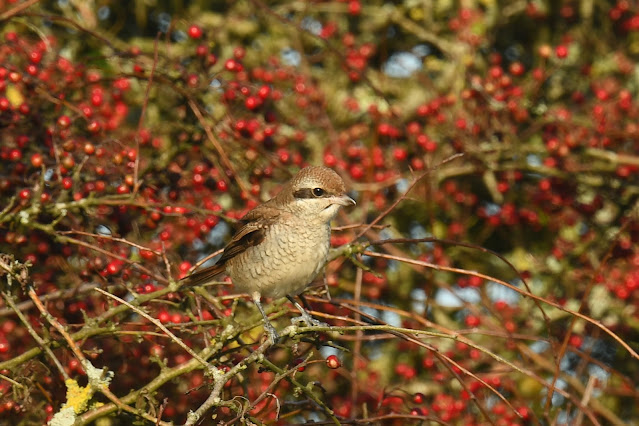
The first major rarity of October was found at Calartha, Pendeen on the 22nd. A mobile and somewhat elusive first winter Brown Shrike was eventually pinned down and identified in the bracken and bramble area opposite Calartha wood.  This species is fast becoming a regular, annual visitor in the UK with at least 39 records to 2020. The Pendeen bird is the 6th record for Cornwall following the first at Kynance in 2009.  Brown Shrike has now occurred in three of the last four years in Cornwall.  A Radde's Warbler was also found on the Lizard.

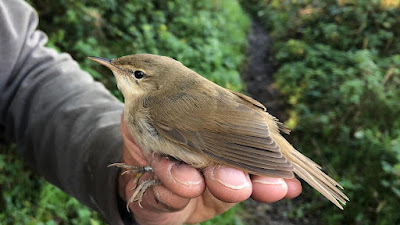
Nanjizal finally came up trumps with a Blyth's Reed Warbler on the 25th.  This important ringing station is the only place that all ten county records have been found.  All have been ringed but as yet, no controls.  The following day an equally rare Marsh Warbler was found in the nets. Yellow-browed Warbler has been scarce this year so one at Porthgwarra and one at Porthcurno were notable (25th).

Cornwall's third Buff-bellied Pipit was found on the Lizard on 30th. Whilst this is a great Nearctic passerine find, local birders were really hoping for a long overdue dendroica!  Of interest, Nearctic passerines are extremely rare on the Lizard with one local birder saying the pipit was just his second.  Two Glossy Ibis remained at Walmsley to the month end and a mobile American Golden Plover was in the Porthgwarra and Chapel Carn Brae area (30th).

Bird of the Month: Brown Shrike at Pendeen.

Runners-up Semipalmated Sandpiper at Carnsew, Blyth's Reed Warbler at Nanjizal and Barolo Shearwater off Pendeen, Buff-bellied Pipit at Lizard.

1w Brown Shrike, Pendeen, pic by Steve Rogers

Blyth's Reed Warbler at Nanjizal, Oct 2021, Pic courtesy Kester Wilson

Brown Shrike at Pendeen, 22nd October 2021

 Peter Combridge found a Red-backed Shrike late afternoon near Calartha wood, Pendeen and phoned the news out to locals. The bird was always mobile, feeding well as if just arrived and was difficult to pin down.  After some brief views Peter said it could be a Brown Shrike based on the brown mantle and generally brownish look to the upperparts.  Nigel Rogers was also thinking along the same lines.  Myself, Peter Clement and Mashuq Ahmad later relocated the bird lower down the valley in fading light.  In the two minute scope views we had, we managed to see and photo the key Brown Shrike features that Peter Combridge raised earlier eg. outer tail feather, brown mantle con-colourous with the crown and tail, strong dark mask, lack of upperpart barring and the well barred flanks. (Thanks to Pete Combridge for finding it and getting the news out promptly). 

Brown Shrike breeds in Siberia from the Ob River basin East to the Sea of Okhotsk and Kamchatka, North Japan and throughout much of East China.  Winters in the Indian Subcontinent.  To the end of 2020, there are 39 UK records.

In Cornwall the first record was in 2009 at Kynance, Lizard, followed by a stunning adult female on the cycle track at Sennen in May 2010.  Of interest, the valley from Calartha down to the coastguard houses is arguably the best site in Cornwall for shrikes. Daurian, Turkestan, Red-backed and now Brown Shrike have all been recorded here.

Previous Cornwall records:

2009 Sept, Kynance Road, Lizard

2010 May, Sennen

2015 Oct, Porthgwarra

2018 Sept, Soapy Cove, Lizard

2020 Oct, Chapel Porth, St Agnes (yet to be submitted)

2021 Oct, Calartha Valley, Pendeen

Pic by Steve Rogers.

Birding highlights in Cornwall September 2021

 September weather started with an easterly to north easterly airflow.  The month ended with strong south west to north westerly winds.

Little Stints were unusually plentiful with a group of nine on Hayle Estuary.  Elsewhere smaller groups of two's and three's could be found.  The influx was mirrored nationally with a significant number of Little Stints also arriving in the UK during the first week of September.  More info can be found HERE in this Birdguides link.

Little Stint at Hayle Estuary (Steve Rogers)

Wrynecks were recorded at the normal coastal sites including Land's End loop, Porthgwarra, Pendeen and Polpry. A Red-backed Shrike appeared at Boscreggan on the 3rd (2nd Autumn record) and an Ortolan Bunting was trapped in the nets at Nanjizal.  This species has recently become a sought-after county rarity, eg in 2019 there no reports at all.  Whinchats and Pied Flycatchers continued to be found in the coastal valleys.  Three juv Spotted Redshank at Stithians Res. were also notable.

The first decent rarity of September was a Greenish Warbler, appearing on the 5th at St Levan.  This is just the 10th record for Cornwall.  The wandering Glossy Ibis appeared at St Gothians on the 6th.

Flycatchers have been ever present from the end of August, but a sizable fall occurred on the 7th on the north coast.  Trevose recorded 49 Spotted and 8 Pied,  Kenidjack 33 Spotted and 3 Pied and Botallack another 4 Spotted and a single Pied.  Numerous other sightings of singles were also reported.  The true number across the county will never be known but suffice to say, this was the largest fall for many years.  A Dotterel was also found at Park Head on the 7th.

Spotted Flycatcher, Pistil Meadow, Lizard.

A large fall of passerines occurred on Wednesday 8th Sept with at least 12 Wrynecks, one Red-backed Shrike (Cadgwith) and another Wood Warbler at Pendeen. A Bonelli's warbler unassigned to species level was found at Land's End on the 9th.

The wind turned westerly overnight on the 10th.  At least seven adult Sabine's Gulls including a flock of four were seen off Pendeen and another at St Agnes. The largest movement of 17 Arctic Skuas was also recorded so far this season. 

Drift migrants continued to be found on the 11th with a Red-backed Shrike appearing at Sancreed.  This unusual location was just reward for Dave Flumm's perseverance.  It was Dave's 174th record from his house. The astonishing number of Wrynecks to be found continued, with at least a dozen on coastal headlands. Osprey continue to be recorded daily from Ruan Lanihorne over the last five days.  An adult Honey Buzzard flew north over Mullion (11th).


Wryneck at Pendeen 17th Sept 2021.

Three Glossy Ibis' appeared at Hayle Estuary on the 13th with another also at Drift. Another or same was found the following day at Foxhole.  An Ortolan and Nightingale were found at the Lizard on the 14th.  The juv Red-backed Shrike at Sancreed was still present for its fourth day.  A Dotterel was heard calling over Porthgwarra.  The first juv. Rose-coloured Starling of the season was found at the traditional site at Land's End complex.  A juv. Barred Warbler appeared at Portherras on the 16th.  

A change of weather overnight resulted in the first (?) Pectoral Sandpiper of the season at Carnsew. A Wilson's Petrel was seen for three minutes at East Pentire on the 17th.  This species has been non existent on sea watches this year so a well viewed bird was a welcome find for Steve Rowe.  A Pomarine Skua and Long-tailed Skua were seen off Pendeen.

The long staying Red-backed Shrike finally departed Sancreed on the 21st after eleven days in the same hedge.  It must have found something nice to feed on!  The juv Rosy Starling was still in the Sennen area on the 22nd.

A flock of two Pectoral Sandpipers were found at Stithians Res. on the 24th.  Another was seen at Loveny, Colliford.  So far this Autumn, Nearctic waders have been woefully short on supply.  Two juv Spoonbills put in a brief appearance at Marazion with one remaining until the month-end.

The wind turned north westerly overnight on the 28th.  A reasonable seabird movement of 23 Arctic Skuas, one Long-tailed Skua, two Leach's Petrels, Black Tern and 117 Balearic Shearwaters passed Pendeen on the 29th.  The month ended with more strong westerly winds and a decent haul of Balearic Shearwaters, eg 126 at Pendeen on the 29th.

Bird of the month: Greenish Warbler at St Levan
Runners up: Unusually high numbers of Little Stint, Wryneck, flycatchers and a single Wilson's Petrel.

Rufous Bush Chat at Coverack, Lizard, Sunday 22nd August

 A Rufous Bush Chat was found near Coverack on the Lizard on Sunday 22nd August.  Of all the predictions for the next first for Cornwall, this species was definitely not on the radar.  Its also just the 10th record for the UK.  (Another was found in Norfolk last year but that was the first in 40 years).  I still can't believe this species turned up in Cornwall.  It will surely be the bird of the year.

The lucky finder was Lizard stalwart Dougy Wright, out on a casual midday walk with his wife!  Steve Bury had also birded this same path the day before, so we can at least presume it had just arrived. It was tame and very showy, oblivious to its admirers.

The species has at least two obvious forms and this one has been identified as the Eastern form Syriacus. There is strong contrast between the rufous tail and pale grey-brown mantle. 

Syriacus breeds in the Balkans, Greece, Middle East and Turkey.  The species winters in NE and E Africa, from Sudan through Ethiopia to Somalia and Kenya. (P.Clement)

UK records:

1854 Nr Brighton, East Sussex

1859 Start Point, Devon

1876 Slapton, Devon

1951, Nr Dungeness, East Sussex/Kent

1959 Prawle Point, Devon

1963 Skegness, Lincs.

1972 Flamborough, N Humberside

1980 Prawle Point, Devon

2020 Norfolk

All records have occurred between 9th Aug and 20th Oct, majority in Sept.  (A further three have been recorded in SW Ireland).

Image by Paul Freestone 


Black-winged Stilt at Marazion marsh - 21st June 2021

  On Monday afternoon the RSPB warden found an adult male Black-winged Stilt at the new scrape on the marsh.  It stayed overnight and was enjoyed by scores of local birders as it fed well at fairly close range.  I managed to obtain some really pleasing pics the Tuesday morning from 05.30, along with Reuben Veal.  For an hour we had the bird to ourselves in stunning early morning light.  This is the first record since May 1992 at the marsh.

Black Kite at Porthgwarra 18th June 2021

 On Friday 18th June, Patsy and me found a Black Kite on the west side of the moor at Porthgwarra at 09.58.  It seemed to come in off the sea and headed towards Nanjizal, being mobbed by a local Peregrine.  It flew about 100 ft above us and moved steadily north east.  I managed to get a few record shots.  Its the second bird we have seen this Spring and was a different bird to the earlier one.  This one was aged as a probable 3 cal year bird.  It was obviously in serious feather moult and might also have been shot at as the feather condition was poor. 


Saturday, 18 June 2022

Pacific Golden Plover at Stithians Res. June 2022

 An adult Pacific Golden Plover was found at Stithians Reservoir in front of the Stuart Hutchings hide on Wednesday 15th June by Charlotte Foote and Thomas Weston. They were convinced that it was a Pacific from the outset, having seen one in Norfolk last year, but were persuaded by a national information service that it was an American. Perseverance pays as local birders including John Ryan soon confirmed the original id.  Pacific Golden Plover is a great personal find as this is only the 7th Cornwall record. Five of the records have been recorded in the summer months and are wandering non-breeders.

Pacific Golden Plover is a difficult species to identify, though improved knowledge and better photographic equipment makes id easier now. All seven Cornwall records have been tricky to confirm; indeed three were reviewed and latterly confirmed as this species.

The species breeds across the Siberian tundra to west Alaska. It migrates to the Indian subcontinent and as far south as New Zealand and Australia.

All records:

2022: Stithians Res, an adult in breeding plumage, 15th-16th June.

2018: St Gothians, an adult in breeding plumage 29th June to 1st July.

2011: Hayle Est. an adult from 19th-20th July.

1999: Culdrose, an adult commuting between the airfield and ploughed fields adjacent to the main road, 19th-29th October.

1998: Bosanketh, St Buryan, close scrutiny revealed it to be Pacific, 3rd-4th May.

1994: Hayle Est. an adult moulting from summer plumage, 26th Aug.

1978: Stithians Res. juv originally accepted as an American Golden Plover and reviewed, 7th Nov.

Pacific Golden Plover, Stithians Res, June 2022 (pic S Rogers).


Monday, 10 June 2019

Greenish Warbler at Porth Joke and status in Cornwall

Greenish Warbler is a rare vagrant in Cornwall with just eight records up to June 2019. The two  records in 2019 are the first in Spring in Cornwall.  The species breeds in north and eastern Europe and Russia and has expanded its breeding range westwards during the last century. Migrates south east to winter in S. Asia.

1984: Nanquidno, 30th Sep to 1st Oct. Found by Dave Flumm. Paul Semmens, Lawrie Williams, Stuart Hutchings and Graham Hearl were also named as co-finders. It was present for two days and preferred the high canopy of the sycamore tree by the farmhouse with blue windows. It was also seen in the copse by the ford. This individual was by no means an easy ID and several observers of the day considered this to be a Two-barred Greenish.

2000: Kenidjack, 24th Sep. Found by John Swann and T. Whiley. This bird again spent much of the time in the high canopy in the copse part way down the valley.

2008: Pendeen, 16th to 17th Sep. Found by John Foster. This individual was found in the copse around Calartha Farm on the road down to Pendeen Watch. It was highly active and elusive at times. It was occasionally seen in the gardens adjacent to the copse.

2009: Church Cove, Lizard. 28th Oct to 1st Nov. Found by visiting birder Duncan Poyser from Cambs. Initially found at the bottom of the valley near Mariner's Cottage. The bird was highly mobile and could be found in the sycamores and elms in the churchyard as well as the copse at the bottom of the valley. This individual will be long-remembered for its see-saw identification between Green and Greenish. Eventually confirmed by sonogram on the call by Magnus Robb, Ilya Maclean and Hugh Harrop.

2010: Treeve Common, Land's End. 25th-29th Sep. Found by John Chapple.

2016: Porthgwarra, 24th August, M Elliott, J F Ryan.

2017: Millbrook, St Andrew's Street. 23rd-25th Aug.

2019: Lizard Village. 4th June. One seen briefly by Tony Blunden.

2019: Porth Joke, Crantock. 9th June. Singing male in willows below Treago campsite, found by Steve Rowe.

Male Greenish Warbler, Porth Joke 9th June 2019.


Wednesday, 5 June 2019

Black-headed Wagtail at the Lizard

An adult male Black-headed Wagtail was found at the Waterings, Housel Bay, Lizard on Sunday 19th May by Tony Blunden.  It spent all day in the cattle field catching insects.  The record followed a strong easterly air flow directly from Scandinavia.  It was present for just one day.

I have seen a lot of this sub species of Yellow Wagtail abroad in Cyprus, and this bird is one of the purest I have seen.  There was no white in the chin or hint of any supercilium.

A look at past Cornwall records makes this bird the third record.  Several previous records have been rejected on review or just not submitted, see below data kindly supplied by Derek Julian.

Ad male Black-headed Wagtail, Lizard, May 2019


Yearly sightings:

1964 – One at Marazion Marsh 29th June. (After review in 1993 was found as unacceptable by BBRC). [8] [12]

1978 – One at Pentire Farm, Polzeath 5th June. (After review in 1993 was found as unacceptable by BBRC) [9]

1999 – One, male, at Walmsley Sanctuary 11th-12th May. (Evans says present 3 days on about 10th/11th May) [1][2][3][10]

2000 – One at Maer Lake 25th-28th May. (Not submitted to BBRC?) [11]

2010 – One first summer male at Land’s End 29th April to 1st May. [4][5][6]

(2011 – One male at Drift Reservoir 16th September. [14] )

2016 – One female from Land’s End Cycle path 18th May. (Not submitted to BBRC?) [7]

(2019 – One adult male at Housel Bay, Lizard 19th May. [7] )


Site Records:

Camel Estuary

1999 – One male at Walmsley Sanctuary 11th-12th May. [1][2][3][10]

Drift Reservoir

(2011 – One male at Drift Reservoir 16th September. [14] )

Land’s End

2010 – One first summer male 29th April to 1st May. [4][5][6]

(2016 – One female from Land’s End Cycle path 18th May. (Not submitted to BBRC?) [7]

(Lizard

2019 – One adult male at Housel Bay, 19th May. [7] )

(Maer Lake

2000 – One at Maer Lake 25th-28th May. (Not submitted to BBRC?) [11])

(Marazion Marsh

1964 – One at Marazion Marsh 29th June. (After review in 1993 was found as unacceptable by BBRC). [8] [12])

(Pentire Head

1978 – One at Pentire Farm, Polzeath 5th June. (After review in 1993 was found as unacceptable by BBRC) [9])

References
1 – Slack R, Rare Birds Where and When Vol 1, page 129.
2 – Evans LGR, Black-headed Wagtails on Powys, Cornwall and Essex in Rare Birds Vol 5 No 3, page 204
3 – Rogers, MJ and the Rarities Committee, British Birds Vol 93, page 548
4 – Hudson, NAJ and the Rarities Committee, British Birds Vol 104, page 617;
5 – British Birds 109: plate 220
6 – Birding World 23, page 188
7 – CBWPS Website
8 – CBWPS Thirty-fourth Annual Report 1964, page 45.
9 – CBWPS Birds in Cornwall 1978, page 59.
10 – Birds in Cornwall 1999, page 91.
11 – Birds in Cornwall 2000, page 101.
12 – Rogers, MJ and the Rarities Committee, British Birds Vol 87, page 543.
13 – Rogers, MJ and the Rarities Committee, British Birds Vol 93, page 548.
14 – Julian DI, Personal Records.
Reference(s): Birding World 23 (5): 188, photo; N. A. J. Hudson and the Rarities Committee, British Birds 104: 617; British Birds 109: plate 220