The second Woodchat of the season was found yesterday in the donkey field on the road between Kelynack and the Youth Hostel at Cot Valley. The bird seen at Kenidjack last week was clearly different to the one seen today; based on the amount of white on the lores and forehead, this bird is presumably a female. The amount of grey in the mantle also suggests a first summer bird. The bird was always quite distant favouring the gorse bushes at the bottom of the valley.
For the keen eyed observers, the images are not quite as sharp as they normally appear on this blog. The reason is that they were taken with an old second hand Nikon D2H camera boasting a "massive" 4.1 mega pixel sensor! It can still churn out 8 frames per second though. This model was launched way back in 2003 but can still just about hold its own among the latest crop of 36 mega pixel cameras.
Sunday, 21 April 2013
Friday, 19 April 2013
Birding on Boa Vista, Cape Verde - part 3 - seabirds
This post is my final post on a birding trip to Boa Vista, Cape Verde in March. This post concentrates on seabirds, which was my main area of interest on this trip. The archipelago in general is extensive and to get to all parts in a two week period is difficult, so I had to give the north-west part a miss. This was a bit of a shame as the largest seabird concentrations are in this corner. That said, I managed to get out on a whale watching trip(65 Euros) and also as an observer on a deep sea fishing safari (60 Euros) to catch Wahoo and Tuna. The latter trip lasted six hours and travelled 20 miles out - perfect.
The highlight was two White-faced Storm Petrels. This charismatic species breeds fairly close nearby on an islet called Ilheu dos Passaros in the north east of Boa Vista. However they only arrive on the islet at nighttime and are difficult to see in the day. As you can imagine I was delighted to see this bird but disappointed that no photo's were taken. I also saw several Cape Verde Petrel and two Red-billed Tropicbirds.
The commonest species was Brown Booby and they can be seen at close quarters along the surf of the beach as they dive at a low angle to catch fish, hence several photos are shown below. The species breeds on the small offshore island of Currel Velho, about two kms east of the hotel. There are about 100 pairs breeding here. It was here that I saw what I originally thought was a Masked Booby though I am now pretty sure this is a young Brown Booby. Comments are welcome on this.
In addition to the common Brown Booby's, I also saw in total about ten Red-billed Tropicbird and a female Magnificent Frigatebird patrolling over Currel Velho. The male was apparently sitting on the nest. This pair is now the only two resident birds in the Western Palearctic. Two females have not definitly been seen together for a many months (per Pedro, local birder) so it seems this pair will soon become extinct here.
About a km off the hotel beach, I was also very lucky to see a mother Humpback Whale and calf leaping out of the sea. The image below is not the best but it does show the adult jumping and the splash to the left is the other one already going under.
The highlight was two White-faced Storm Petrels. This charismatic species breeds fairly close nearby on an islet called Ilheu dos Passaros in the north east of Boa Vista. However they only arrive on the islet at nighttime and are difficult to see in the day. As you can imagine I was delighted to see this bird but disappointed that no photo's were taken. I also saw several Cape Verde Petrel and two Red-billed Tropicbirds.
The commonest species was Brown Booby and they can be seen at close quarters along the surf of the beach as they dive at a low angle to catch fish, hence several photos are shown below. The species breeds on the small offshore island of Currel Velho, about two kms east of the hotel. There are about 100 pairs breeding here. It was here that I saw what I originally thought was a Masked Booby though I am now pretty sure this is a young Brown Booby. Comments are welcome on this.
In addition to the common Brown Booby's, I also saw in total about ten Red-billed Tropicbird and a female Magnificent Frigatebird patrolling over Currel Velho. The male was apparently sitting on the nest. This pair is now the only two resident birds in the Western Palearctic. Two females have not definitly been seen together for a many months (per Pedro, local birder) so it seems this pair will soon become extinct here.
About a km off the hotel beach, I was also very lucky to see a mother Humpback Whale and calf leaping out of the sea. The image below is not the best but it does show the adult jumping and the splash to the left is the other one already going under.
![]() |
| Female Magnificent Frigatebird, with juv Brown Booby (sixth from left) and adult Brown Booby's |
![]() |
| Presumed juv Brown Booby (centre) |
![]() |
| Pair of adult Brown Booby |
![]() |
| Adult Brown Booby at dusk |
![]() |
| Pair of juv Brown Booby - the line is tangled fishing gut caught round its leg. |
![]() |
| Add caption |
Thursday, 4 April 2013
Birds in Cornwall - March round-up
With the extremely cold weather averaging just 2.2 degrees in March, there was much dispondency about the birding scene in Cornwall. Indeed, March 2013 was officially pronounced by the BBC as the coldest since 1962. That said, there has been some stunningly bright and clear days, ideal for mopping up those not-so-rare birds in the county. As it happens, there has been a lot to see. Three species in particular stand out for me. Common Scoter, Red-necked Grebe and Lapland Bunting are normally really difficult to see well, let alone photo. And they have offered themselves on a plate!
On the extreme rarity front, the regular, returning Pacific Diver has been pretty tricky to see in Mount's Bay, often seen to the east of the Mount. The drake Lesser Scaup is presumably also a returning bird, popping up regularly at Colliford and more recently at Siblyback Res. I saw the drake Ring-necked Duck last Sunday at Par beach pool, neck-stretching regularly and showing its purple namesake. Continuing with the waterbird theme, drake Goosanders have been very photogenic at St Andrew's Pool and also last week one at Hayle. Black-throated Divers are now approaching summer plumage and can be seen in numbers in Gerrans Bay, sometimes quite close. A decent raft of 50 or so Common Scoter could be seen at Porthpean and if lucky, a Velvet Scoter as well.
On the wader front, several Little Ringed Plovers were seen at the end of the month, with an obliging pair frequenting the scrape pool at St Gothians. Others have been seen at Treraven Meadows. A Black-tailed Godwit at Marazion was showing characteristics of the limosa race and mirrors the record of one at the same place and same date last year.
The normal early passerines battled the extreme wind and cold only to find little food here. A large fall of Chiffchaffs were resorting to feeding on grass verges and gardens - but how many perished? A Hoopoe was found moribund at St Agnes. There were good numbers of Sand Martins at the normal venues and Northern Wheatears tried to make it feel something like Spring.
So all in all, despite the bitter conditions, there were a few good birds to be seen. Some images I took are shown below:
On the extreme rarity front, the regular, returning Pacific Diver has been pretty tricky to see in Mount's Bay, often seen to the east of the Mount. The drake Lesser Scaup is presumably also a returning bird, popping up regularly at Colliford and more recently at Siblyback Res. I saw the drake Ring-necked Duck last Sunday at Par beach pool, neck-stretching regularly and showing its purple namesake. Continuing with the waterbird theme, drake Goosanders have been very photogenic at St Andrew's Pool and also last week one at Hayle. Black-throated Divers are now approaching summer plumage and can be seen in numbers in Gerrans Bay, sometimes quite close. A decent raft of 50 or so Common Scoter could be seen at Porthpean and if lucky, a Velvet Scoter as well.
On the wader front, several Little Ringed Plovers were seen at the end of the month, with an obliging pair frequenting the scrape pool at St Gothians. Others have been seen at Treraven Meadows. A Black-tailed Godwit at Marazion was showing characteristics of the limosa race and mirrors the record of one at the same place and same date last year.
The normal early passerines battled the extreme wind and cold only to find little food here. A large fall of Chiffchaffs were resorting to feeding on grass verges and gardens - but how many perished? A Hoopoe was found moribund at St Agnes. There were good numbers of Sand Martins at the normal venues and Northern Wheatears tried to make it feel something like Spring.
So all in all, despite the bitter conditions, there were a few good birds to be seen. Some images I took are shown below:
![]() |
| Drake Common Scoter at Swanpool was very confiding |
![]() |
| Common Scoter - image taken pointing into the sun's glare EV +1.0 |
![]() |
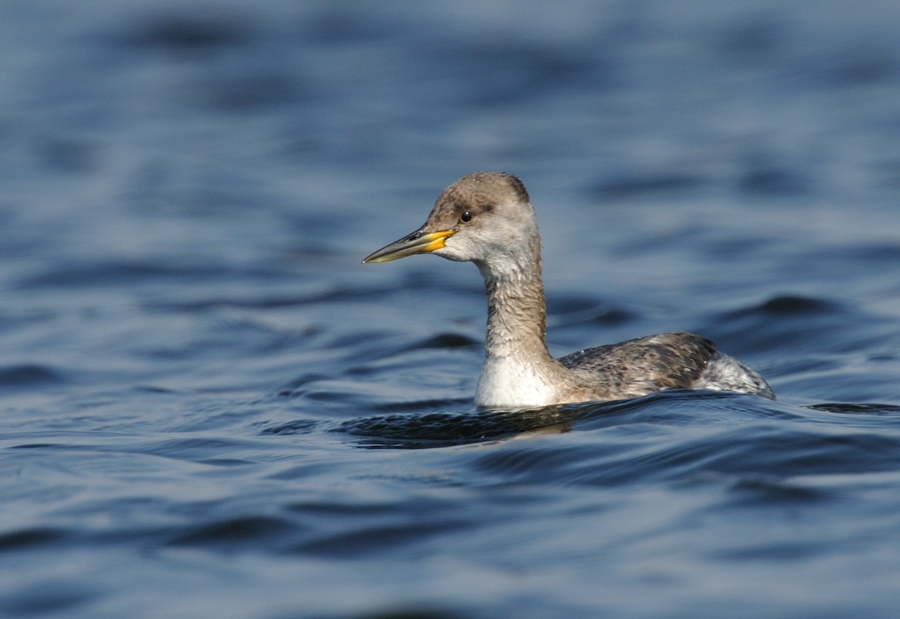
| Red-necked Grebe at Siblyback Reservoir |
![]() |
| Drake Goosander at St Andrew's, a popular site for this species |
![]() |
| Little Ringed Plover at St Gothian Sands NR - greater numbers than normal arrived in the South West in March |
![]() |
| Pair of Little Ringed Plovers at St Gothian Sands |
![]() |
| Black-tailed Godwit at Marazion Marsh |
![]() |
| Drake Northern Pintail at St Gothian Sands NR at the end of March |
![]() |
| Male Lapland Bunting approaching summer plumage - up to 100 birds were counted at Rosenannon Downs near Wadebridge. |
![]() |
| Male Northern Wheatear at Marazion Marsh. |
Thursday, 28 March 2013
Red-necked Grebe at Siblyback Reservoir, Cornwall
A Red-necked Grebe has been present since Saturday 23rd March at the unlikely inland location of Siblyback Reservoir. I saw it well today with Nigel Climpson and Sid Cole. It seemed to be feeding on a wide circuit mainly from the dam end and the shallower water just to the south of the dam. Twice it came to within 25 metres of us as it continued on its steady circuit. Red-necked Grebes are chiefly found in the sheltered, coastal bays between the Helford River and St Austell Bay. Inland records are unusual, but very welcome of course as this is the first opportunity I have had to see one at close quarters. Considering the very dull plumage, presumably this is a non breeding adult.
On returning to the car, I also found a male Ring Ouzel (image below).
![]() |
| Male Ring Ouzel found on the west side of the dam on the sloping fields (with sheep grazing in). |
Wednesday, 27 March 2013
Drake Common Scoter on Swanpool, Falmouth
A drake Common Scoter has been present on Swanpool for the last couple days. Whilst the species is fairly common around the Cornish coast, most sightings are half a mile away and usually distant. When I heard of a drake on Swanpool I decided to take a closer look this morning. I couldn't believe how tame and curious this bird is! It followed me round the pool. I had to take the converter off and backtrack to the normal 5 metres close focus for the 600mm lens. I've never seen any scoter this close, not even at Slimbridge. This male was a little stunner and well worth the visit. I was also lucky with the light this morning, varying from sunshine to overcast, hence the differing colours in the images.
Sunday, 24 March 2013
Birding on Boa Vista, Cape Verde - part 2 desert birds
This post is the second installment of some of the birds seen on Boa Vista, one of the main islands of Cape Verde. Desert birding features prominently here. Whilst the number of species is typically limited on a remote island, the quality makes up for the paucity of birds. I connected with everything possible on this island. (To see other species such as Alexanders Swift, Razo Lark and Cape Verde Warbler, you have to visit another two islands). Cream-coloured Coursers were reasonably common in suitable semi-arable / desert habitat. On one occasion I found a group of 12 birds feeding together.
Hoopoe Larks were common with breeding pairs and singing males within earshot of the hotel. Within a couple hundred metres of the hotel there were many birds easily encountered. Bar-tailed Larks were also common. Singing males could be heard either side of the hotel but the flat area to the west seemed to be preferred. The miniture serin-sized Black-capped Sparrow Larks were uncommon and restricted to some old arable "farmland" about one mile north of the hotel. These inquisitive little larks have a distinctive song and flight display. A displaying male attracts several females as they watch in awe!
Spectacled Warblers were common and had already gone past courtship and display rituals. Males and females were attending to young in the nest. Iago Sparrow was surprisingly scarce. I only saw one pair. In contrast, there were hundreds of Spanish Sparrows.
Osprey was common and I saw several near the coast. I managed to see one Cape Verde Peregrine and luckily got a few shots as well. This is apparently quite a rare bird here. A pair of Alexanders Kestrel were breeding in the hotel grounds. I also saw a second year male Marsh Harrier.
Hoopoe Larks were common with breeding pairs and singing males within earshot of the hotel. Within a couple hundred metres of the hotel there were many birds easily encountered. Bar-tailed Larks were also common. Singing males could be heard either side of the hotel but the flat area to the west seemed to be preferred. The miniture serin-sized Black-capped Sparrow Larks were uncommon and restricted to some old arable "farmland" about one mile north of the hotel. These inquisitive little larks have a distinctive song and flight display. A displaying male attracts several females as they watch in awe!
Spectacled Warblers were common and had already gone past courtship and display rituals. Males and females were attending to young in the nest. Iago Sparrow was surprisingly scarce. I only saw one pair. In contrast, there were hundreds of Spanish Sparrows.
Osprey was common and I saw several near the coast. I managed to see one Cape Verde Peregrine and luckily got a few shots as well. This is apparently quite a rare bird here. A pair of Alexanders Kestrel were breeding in the hotel grounds. I also saw a second year male Marsh Harrier.
![]() |
| Black-capped Sparrow Lark - an intriguing little lark, fairly localised in suitable habitat |
![]() |
| Adult Hoopoe Lark - a common bird. |
![]() |
| Juv Hoopoe Lark, just fledged. |
![]() |
| Bar-tailed Lark. |
![]() |
| Male Iago Sparrow, one of only two seen all trip. |
![]() |
| Male Spectacled Warbler - a common bird. |
![]() |
| Adult Cream-coloured Courser |
![]() |
| Cream-coloured Courser - part of a flock of 12 birds. |
![]() |
| Cape Verde Peregrine - the only sighting. |
![]() |
| Osprey - breeds on the island and fairly common. |
Sunday, 17 March 2013
Lapland Buntings at Rosenannon, Cornwall
Up to 100 Lapland Buntings have been logged at Rosenannon Downs this winter - quite an impressive count. Today though I counted about 37 birds flying around the moor. This number in itself is still a respectable count, though "Lapbunts" seem to be on the increase in Cornwall. In 2011, a massive 150+ birds were found at Port Isaac in early March. This was a Cornwall record number. 20 plus were also at the Lizard Point in January 2012. A smaller flock of 15 birds associating with five Snow Buntings have wintered at Treen Common this year. Historically, there has always been a handful of records annually, mostly from North Cornwall but not in such high numbers as we are finding now.
The species breeds in Arctic Europe, Greenland and Canada. It is highly migratory and is one of the few passerines which routinely migrates back and forth across the Atlantic.
Some males today were showing signs of breeding plumage and one bird seemed to be practicing courtship display. The three images below were taken this morning:
The species breeds in Arctic Europe, Greenland and Canada. It is highly migratory and is one of the few passerines which routinely migrates back and forth across the Atlantic.
Some males today were showing signs of breeding plumage and one bird seemed to be practicing courtship display. The three images below were taken this morning:
![]() |
| Female Lapland Bunting |
![]() |
| Male Lapland Bunting skulking |
![]() |
| Male Lapland Bunting at Rosenannon |
Thursday, 14 March 2013
Birding on Boa Vista, Cape Verde - waders
My wife and I visited the island of Boa Vista in the Cape Verde islands at the end of February and returned on the 12th March. This is the second visit to the archipelago but to a different part. We concentrated on the south east corner of the island and stayed at the Riu Touareg Hotel. Unbelievably, this brand new hotel is located less than a couple miles from Currel Velho island, which hosts the last remaining pair of Magnificent Frgatebirds in the Western Palearctic. In addition, three or four pairs of Red-billed Tropicbird and about 100 pairs of Brown Booby breed here as well. Add to that reports of Masked Booby present on the island and this location suddenly looks very attractive for a winter break combined with some respectable birding.
I was pleasantly surprised to find a very sizable "lake" no more than 500 yards east of the hotel. This is in effect the hotel sewerage treatment pond of some couple acres in size. There were no smells or signs of the solid stuff, but just well treated water continually seaping in to the desert. It was a magnet for waders and I was told by a local birder that this site was now the premier wader site on the island. I counted at least 17 species of wader here, some species in good numbers. Migration was clearly under way with 51 Curlew Sandpipers on the 10th March, some approaching summer plumage. I was also suprised to find two Lesser Yellowlegs and an American Golden Plover (though the latter had already been found by two Belgian birders). I also missed a Temminck's Stint found by a Danish birder. A flock of 60 Black-winged Stilts along with at least 131 Cattle Egrets added to the scene. The place can only get better as the hotel was only opened last autumn.
Photography was not especially easy with a D SLR and 300mm lens plus TC. The longish distance of waders here would probably suit digiscoping better. The high temperatures (Av 30 degs) also limited birding to the early morning and later afternoon. The heat haze was never easy to contend with.
Birding with the 'scope though was stunning and to have a reserve looking like RSPB Titchwell all to yourself was bliss. The first installment of images will concentrate on waders.
Holiday details: Flight from Gatwick, six hours, direct. Hotel Riu Touareg, Boa Vista. Organised through Thompsons First Choice. Transfer to hotel included. No requirement to hire a vehicle as most birds within walking distance of hotel. Requirements: stamina, fitness, dark sunny's, gallons of water and an understanding wife.
I was pleasantly surprised to find a very sizable "lake" no more than 500 yards east of the hotel. This is in effect the hotel sewerage treatment pond of some couple acres in size. There were no smells or signs of the solid stuff, but just well treated water continually seaping in to the desert. It was a magnet for waders and I was told by a local birder that this site was now the premier wader site on the island. I counted at least 17 species of wader here, some species in good numbers. Migration was clearly under way with 51 Curlew Sandpipers on the 10th March, some approaching summer plumage. I was also suprised to find two Lesser Yellowlegs and an American Golden Plover (though the latter had already been found by two Belgian birders). I also missed a Temminck's Stint found by a Danish birder. A flock of 60 Black-winged Stilts along with at least 131 Cattle Egrets added to the scene. The place can only get better as the hotel was only opened last autumn.
Photography was not especially easy with a D SLR and 300mm lens plus TC. The longish distance of waders here would probably suit digiscoping better. The high temperatures (Av 30 degs) also limited birding to the early morning and later afternoon. The heat haze was never easy to contend with.
Birding with the 'scope though was stunning and to have a reserve looking like RSPB Titchwell all to yourself was bliss. The first installment of images will concentrate on waders.
![]() |
| Part of a large roosting flock of Curlew Sandpipers, Sanderling and Ruff |
![]() |
| American Golden Plover - presumably over-wintering at the site. |
![]() |
| American Golden Plover showing the dusky underwing |
![]() |
| Pair of Lesser Yellowlegs |
![]() |
| Displaying Black-winged Stilts - up to 60 were present. |
![]() |
| Adult Wood Sandpiper |
![]() |
| Little Stint feeding by hovering over the water. More will follow on this unusual feeding technique. |
![]() |
| Cattle Egret roost - part of a flock of 131 birds. |
![]() |
| Cream-coloured Coursers - part of a group of 12 birds seen about a mile north of the hotel. A Hoopoe Lark and Bar-tailed Lark are also shown. |
Holiday details: Flight from Gatwick, six hours, direct. Hotel Riu Touareg, Boa Vista. Organised through Thompsons First Choice. Transfer to hotel included. No requirement to hire a vehicle as most birds within walking distance of hotel. Requirements: stamina, fitness, dark sunny's, gallons of water and an understanding wife.
Subscribe to:
Posts (Atom)